
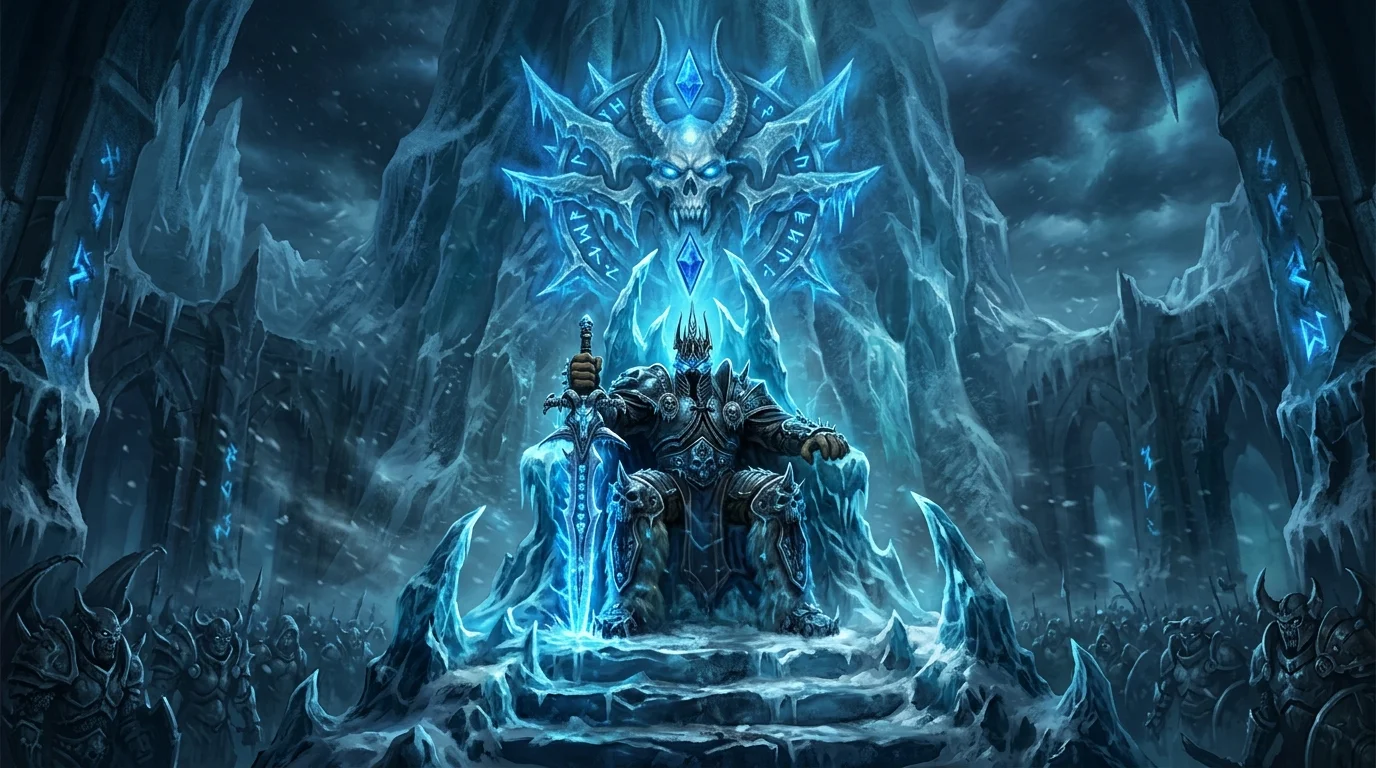
Icecrown as a symbol: what the citadel represents beyond the final battle
Icecrown wasn't just made to be the end of the expansion
Few places in World of Warcraft work as well as a symbol as Icecrown. The entire zone was designed to say the same thing all the time: here the natural world lost, death won and the entire landscape was converted into an instrument of domination.
That's why Icecrown remains strong in the memory even for those who don't care much about raids. The region has a very clear visual language. Ice does not convey peace; it conveys sterility. Saronite does not convey wealth; it conveys desecration. The towers don't look like heroic castles; they look like thorns planted in the world.
Icecrown as a landscape
Before thinking about the raid, it's worth thinking about space.
Eternal ice as denial of life
Icecrown is not “beautiful” in the traditional Northrend sense. It's aggressive. The ice there seems like a force that freezes movement, hope and identity. It is not a contemplative setting; it's a setting of submission.
Saronite as a material wound
The presence of saronite changes everything. The citadel is not made of neutral stone. It is made of a metal associated with the blood of Yogg-Saron. This makes Icecrown a death fortress built from matter already contaminated by another layer of cosmic horror.
The result is a very specific image: the capital of the Scourge is not just necromantic. It is also a monument of physical and mental corruption.
Towers like claws and needles
Icecrown's towers seem to grow upward as if the place were trying to pierce the sky. This verticality helps sell the idea of the final pilgrimage. Everything points upwards, towards the Frozen Throne, towards the center of power.
The construction of the Citadel
The Citadel isn't important just because Arthas sat inside. It matters because it was shaped to be the administrative, military, and symbolic heart of the Scourge.
Who erected it and why
Under the rule of the Lich King, the region was converted into the absolute center of the war against the living. The Citadel functions as a fortress, throne, horror factory, fixed necropolis and political altar. It is not “just a castle”. It is the architectural summary of the Lich King's design.
What it was before it became the final fortress
Before Wrath's final campaign, Icecrown already existed as a glacier, a sacred/haunted region, and a convergence point for the Lich King's power because of the Frozen Throne. The citadel itself is the later crystallization of this centrality. The throne existed as a nucleus. The fortress transforms this core into the capital.
The Frozen Throne at the top
The Frozen Throne works best when read in three layers at once.
Throne
It's where the Lich King reigns, watches, and stands literally above the world. The symbolism of height there is obvious and effective: Arthas sitting high does not rule a city; he governs a reality of fear.
Prison
The Frozen Throne also carries the memory of containment. Ner'zhul was imprisoned, contained, and cast into Azeroth before fusing with Arthas. This means that the top of Icecrown was never just a center of power. It was also a place of confinement.
Reliquary
There too lies a relic of everything the Lich King was: Ner'zhul, Arthas, the armor, the sword, the voice, and the myth. The Frozen Throne doesn't just hold one ruler. It holds a historic fusion.
The final battle as a pilgrimage
The structure of Icecrown Citadel makes the invasion feel like a bitter pilgrimage.
It's not just raid progression
You don't go in, kill a boss and get to the end. You climb layer by layer, wing by wing, monstrosity by monstrosity. This conveys the feeling of traversing the Lich King's entire system before facing him.
Each wing as part of the kingdom of death
Laboratories, military halls, towers, contaminated chambers, val'kyr, blood, plague, abominations. The path to Arthas is not accidental. It was designed to showcase everything that sustains his empire. When the heroes reach the top, they don't just defeat one boss. They go through the entire machine.
Icecrown after Wrath
Arthas' fall does not erase Icecrown.
What remains after the fall of the Lich King
The region remains marked by the Scourge's infrastructure, the memory of the conflict, and the fact that the Lich King's power could not simply disappear without leaving a residue. The place loses its king, but it does not lose its weight.
From final place to permanent wound
This is what makes Icecrown so strong in the lore: it is not just “the last boss zone”. It becomes synonymous with historical trauma. Even after Wrath, any return to the location carries the idea that that ground was once the center of something that almost overcame all of Azeroth.
What Icecrown represents beyond the raid
| Element | What it symbolizes | |---------|------------------| | Eternal ice | sterility, suspension of life and domination | | Saronite | material desecration and latent madness | | Towers | verticality of power and intimidation | | Frozen Throne | throne, prison and relic at the same time | | Citadel | organized death capital | | Final Ascension | pilgrimage to the core of horror |
Why Icecrown works so well
Icecrown works because everything there points to the same idea. There is no visual noise. There is no thematic deviation. The architecture, materials, sky, enemies and spatial progression repeat the message until it becomes unforgettable.
The whole place says that the Lich King turned a piece of the world into an extension of his will.
Minimum recommendation
If you want to read Icecrown as a symbol, it is worth paying attention to these points:
- see saronite as a narrative choice, not just an aesthetic one
- understand the Frozen Throne as power and prison at the same time
- read the raid climb as a pilgrimage against the Lich King's entire system
- think of the Citadel as the capital of death, not just a fortress
- treat Icecrown as a permanent wound of Northrend, even after the fall of Arthas
Posts Recomendados
Northrend Beyond Arthas: The Stories the War Against the Lich King Didn't Tell
Northrend beyond Arthas: before the Lich King, the continent already held troll empires, titanic secrets and nerubian kingdoms. Discover these stories.
Ulduar as a titanic center: what the fortress still holds after Yogg-Saron
Ulduar was never just a raid. It was a prison, laboratory, command center and proof that Northrend was hiding much more than the war against Arthas.
Magtheridon: the pit lord of Hellfire Citadel
Who is Magtheridon: the pit lord who ruled Outland, lost the Black Temple to Illidan and became the blood source for fel orcs in Hellfire Citadel.
Saurfang and Dranosh: father and son of the Horde
Varok and Dranosh Saurfang: the son hidden in Nagrand, his death at the Wrathgate, the Deathbringer in ICC and the father who takes him home. Full arc.