
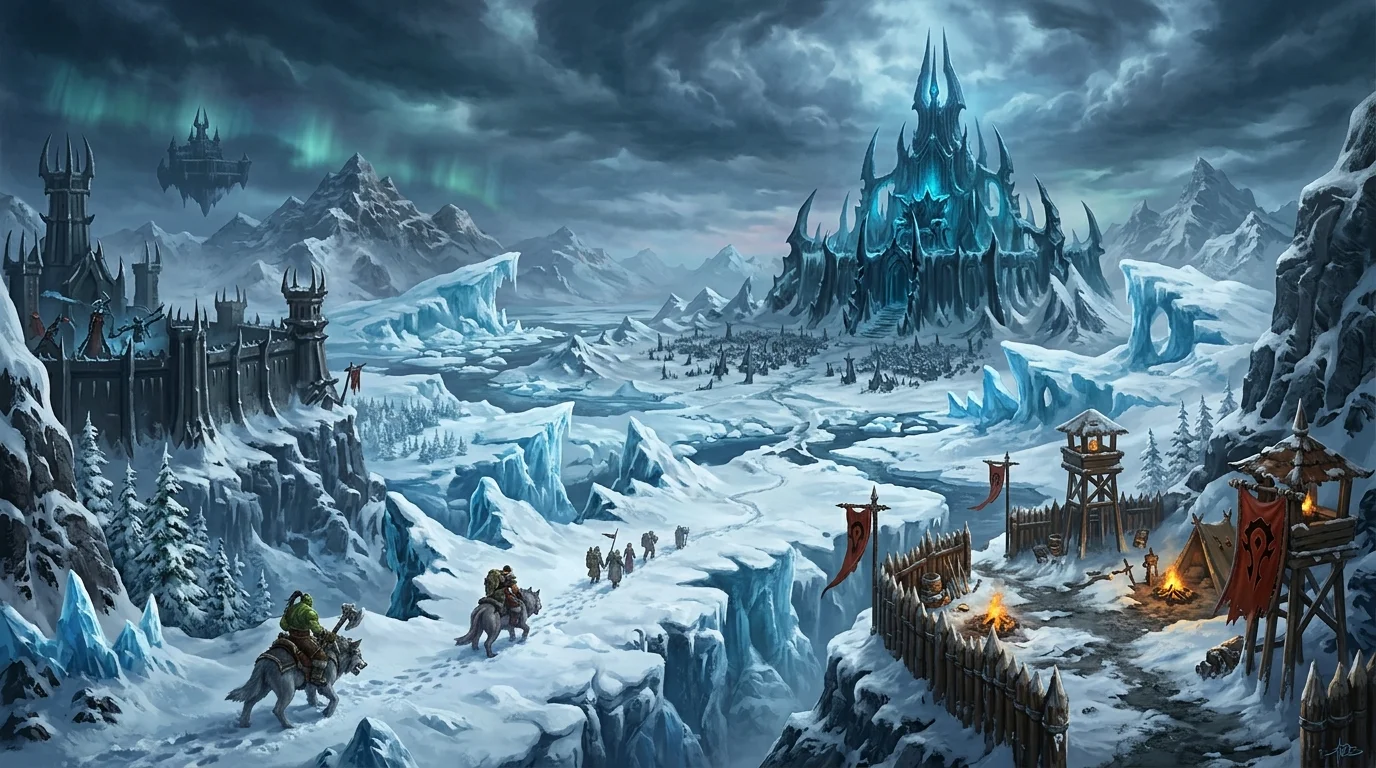
Northrend Beyond Arthas: The Stories the War Against the Lich King Didn't Tell
Northrend was never just the final stage of Arthas
When most people think of Northrend, they think in a straight line: the frozen continent, the march to Icecrown, and the confrontation with the Lich King. But Northrend is much bigger than the story of Arthas. The continent was ancient, strange, and steeped in memory long before the Scourge became its dominant force.
This is precisely the most interesting part of Northrend: it doesn't just function as a war setting. It functions as Azeroth's geological, spiritual and civilizational archive. Each major zone seems to hold a different layer of the world — ancient trolls, subterranean empires, titanic laboratories, and ecosystems that simply shouldn't exist there.
What existed in Northrend before the Scourge
Before Arthas reached the top of the Frozen Throne, Northrend was already a continent full of civilizations and ruins from very different eras.
Vrykul
The vrykul are one of the oldest and most visible layers of Northrend's identity. They are not just “giant Vikings” placed on the map for aesthetics. They are an important piece of human history on Azeroth, because humans descend from the vrykul affected by the curse of the flesh.
In Northrend, they appear as a frozen past in various forms: tombs, fortresses, necropolises, cults, and societies that have survived around a memory of warrior greatness. In many places, they coexist with the influence of the Scourge, but are not born of it.
Nerubians
Before Azjol-Nerub fell under the weight of war and necromancy, the Nerubians were a powerful, sophisticated underground civilization separate from both the trolls and the direct rule of the Lich King. The war against the Scourge destroyed much of what they were, but the continent still preserves signs of that history.
This layer is important because it shows that Northrend already had an articulated underground empire, with its own architecture, hierarchy and collective memory — it wasn't just empty ice waiting for the expansion's villain.
Titans and the titanic complexes
Storm Peaks and Sholazar Basin make this very clear: Northrend is also a continent shaped by titanic engineering. These are not just decorative ruins. There were functions, protocols, observation, experimentation and containment.
This detail changes the reading of the entire continent. Northrend is not a wild wasteland that was once taken over by the Scourge. It was already a strategic territory in the Titans' logic.
Zul'Drak and the tragedy of the Drakkari
Zul'Drak is one of the heaviest stories in Wrath of the Lich King and, at the same time, one of the most underrated.
The last bastion of the Ice Trolls
The Drakkari do not appear in Northrend as a minor or folkloric culture. Zul'Drak is presented as a great religious and political center for its people. The feeling of the area is one of collapsing civilization, not of an isolated tribe.
This matters because the fall of Zul'Drak is not just military. It's cultural. It is the erosion of the last organized bastion of the ice trolls.
The sacrifice of the Loa themselves
The detail that makes Zul'Drak memorable is its desperation. To resist the Scourge, the Drakkari begin to sacrifice their own Loa. It is not a gesture of faith. It's a gesture of panic.
This decision reveals a lot about Northrend as a continent: there, the Lich King didn't just destroy bodies and fortresses. He pushed entire peoples into spiritually irreparable choices. The zone conveys this all the time. You're not just seeing a war; you are watching a civilization devour itself to try to survive.
Storm Peaks and the titanic heart of Northrend
If Zul'Drak shows a dying civilization, Storm Peaks shows a structure too old to fit the scale of mortals.
The titanic center in partial operation
Storm Peaks is not just “the Ulduar zone”. It's the part of Northrend where the continent stops looking medieval-fantastic and starts looking like a colossal installation from another order of the cosmos.
There, the Titan Keepers, the forges, the watchers and the machines make it clear that the Titans didn't just come to visit Azeroth. They organized, monitored and intervened. Storm Peaks is where this logic becomes visible.
The Secrets of the Keepers
Thorim, Freya, Hodir, Mimiron, Loken, Algalon. Each name reinforces the idea that Northrend is also a continent of corrupt titanic administration. The war there is not just between good and evil: it is between original function and deviation, order and contamination.
That's why Ulduar weighs so much within the expansion. It's not just another raid. It's the revelation that, in Northrend, the problem was never just Arthas.
Sholazar Basin and the impossible garden in the middle of the ice
Sholazar Basin exists almost as a visual provocation. After so much ice, ruin and death, you find a vibrant tropical basin, full of life, local conflict and remnants of titanic experimentation.
An assembled ecosystem
Sholazar does not look “natural” in the common sense of the term. It looks preserved, adjusted and maintained. This makes sense within the logic of Azeroth shaped by the Titans: certain places were made to observe, cultivate, test, and maintain life forms.
Oracles vs. Frenzyheart
The conflict between Oracles and Frenzyheart makes the zone seem smaller than it really is, but it helps to show two ways of life that have grown up around this anomaly. Oracles function as makeshift guardians of something they barely understand; the Frenzyheart represent instinct, survival and raw mastery of space.
This contrast helps to remember that Northrend also has zones where the story is not about the Lich King, but about what happens when different peoples occupy a titanic legacy without understanding its full scale.
What was left after Arthas
Arthas's death does not “solve” Northrend. It only ends the absolute hegemony of its greatest warlord.
Ruins that keep talking
After the fall of the Lich King, the continent remains full of structures, mausoleums, prisons, battlefields and destroyed cities that still retain a symbolic function. Northrend doesn't turn a page. Northrend is haunted by its own history.
Living memory, not empty scenery
That's the main point of the continent: it doesn't end with the final raid. It remains important because each zone holds a different part of Azeroth's memory. Trolls show religious desperation. The vrykul show human ancestry. The Nerubians show a buried empire. Storm Peaks and Ulduar showcase titanic engineering. Sholazar shows ecological experiment.
Arthas dominates the main narrative of Wrath, but Northrend was never his alone.
How to read Northrend beyond the main campaign
| Northrend Layer | What it represents | |--------------------|----------------------| | Icecrown | necromantic power, domination and end of journey | | Zul'Drak | civilizational collapse and spiritual despair | | Storm Peaks | titanic presence and cosmic surveillance | | Sholazar Basin | life and preservation experiment | | Azjol-Nerub | underground memory of a destroyed empire | | Vrykul lands | ancestry, war and pre-human legacy |
What Northrend really leaves for WoW lore
Northrend's greatest legacy is showing that an expansion can have a very strong central villain without reducing the entire continent to that villain.
Arthas is the dominant figure of Wrath of the Lich King. But the continent remains bigger than him. And perhaps that's precisely why Northrend remains so strong in the memory of those who play: because it feels like a place that existed before the expansion began and that would continue to exist even if the main campaign had never happened.
Minimum recommendation
If you want to understand Northrend more fully, it's worth looking at the continent in this order:
- start with Zul'Drak to feel the tragedy of the Drakkari
- pass through Storm Peaks to see the scale of the titanic presence
- view Sholazar Basin as a worldbuilding piece, not as a “light” zone
- read Icecrown as a political and spiritual conclusion — not just a military one
- remember that Arthas dominates the campaign, but does not exhaust the continent's history
Posts Recomendados
Icecrown as a symbol: what the citadel represents beyond the final battle
Icecrown isn't just Wrath's final raid. It is a landscape constructed to look like a wound, an altar, a prison and a capital of fear at the same time.
Ulduar as a titanic center: what the fortress still holds after Yogg-Saron
Ulduar was never just a raid. It was a prison, laboratory, command center and proof that Northrend was hiding much more than the war against Arthas.
Saurfang and Dranosh: father and son of the Horde
Varok and Dranosh Saurfang: the son hidden in Nagrand, his death at the Wrathgate, the Deathbringer in ICC and the father who takes him home. Full arc.
Dalaran in Northrend: why the city flew
Dalaran in Northrend: why the Kirin Tor took the city into the sky over Crystalsong, who rules it and what the Violet Hold keeps locked. See the summary.