
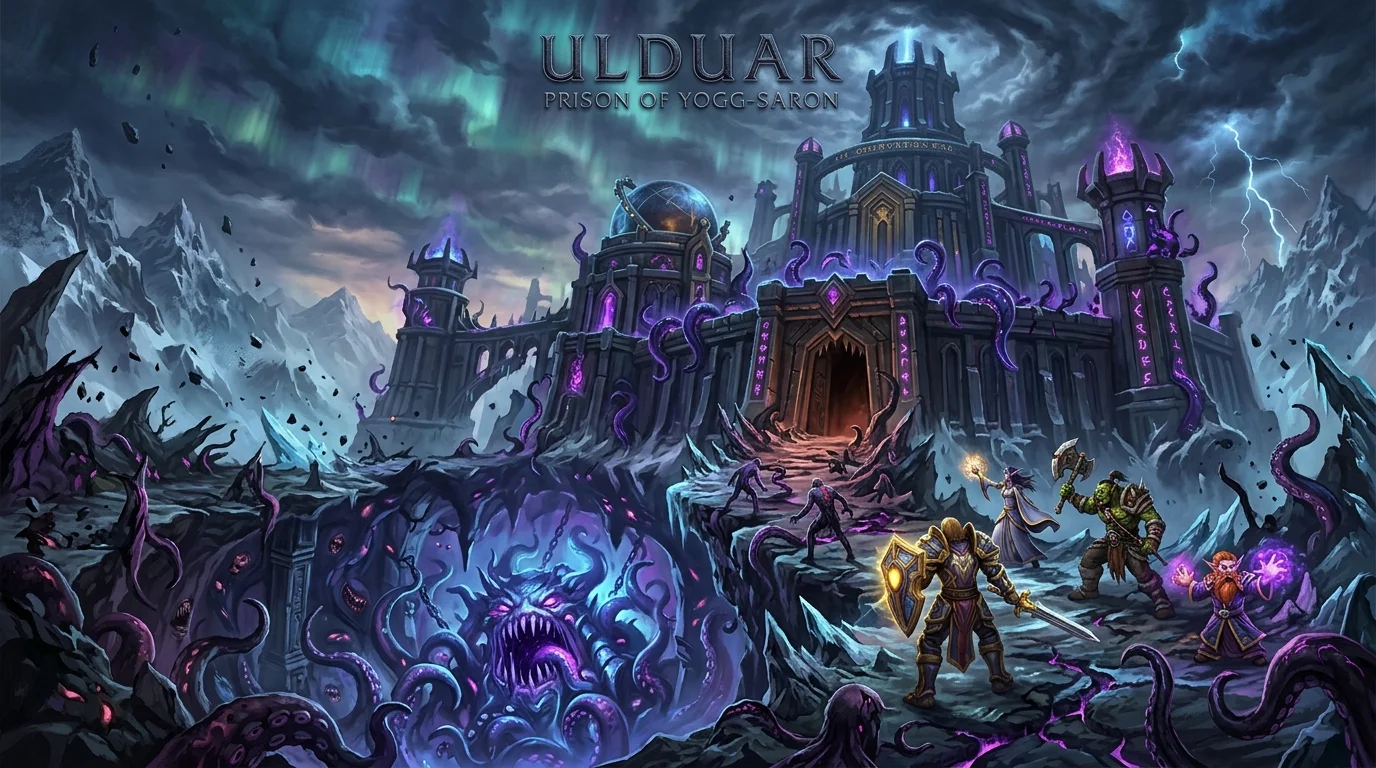
Ulduar as a titanic center: what the fortress still holds after Yogg-Saron
Ulduar is one of the biggest proofs that Northrend was never just about Scourge
When Ulduar appears in Wrath's story, it explodes the scale of the expansion. Until then, the conflict seems to be heading towards the Lich King as the main absolute axis. But Ulduar does something else: it opens the door to the fact that Northrend was also a land of titanic administration, cosmic containment, and institutional corruption.
This is why Ulduar remains so fascinating. She is not just the prison of Yogg-Saron. It is a place where order, science, surveillance and catastrophe coexist within the same structure.
Ulduar before being prison
Ulduar's original function is essential to understanding its weight.
What the Titans built there
Ulduar was not an ornamental fortress. It was a large-scale titanic complex. This includes observation, forges, systems management, production, guarding and maintenance of protocols linked to the order of the world.
When you look at Ulduar as “city of Keepers”, everything makes more sense. It wasn't just a gigantic safe. It was an operational center.
More than a temple, less than a mortal city
Ulduar also doesn't fit well into Azeroth's common categories. It is not a temple in the traditional religious sense, nor an ordinary city. It's an installation. A place where beings in charge of maintaining order on Azeroth lived, managed routines and responded to very specific functions.
The dual function: laboratory and maximum prison
This is the point that makes Ulduar so narratively rich.
Yogg-Saron Prison
Ulduar guarded the Old God Yogg-Saron. This in itself would justify a gigantic structure. But the interesting thing is that the prison does not exist isolated from the rest of the complex. It coexists with laboratories, forges, archives and command instances.
Observation and intervention center
In other words: Ulduar wasn't built just to lock something horrible in the basement. It also served to observe the world, maintain processes, and ensure that Azeroth remained within certain parameters of order.
This makes the place seem more dangerous after the corruption, not less. Because when a containment center fails, it doesn't fail alone: it takes with it the entire system that supported it.
The Titan Keepers before corruption
The Keepers are important because they give Ulduar a functional face.
Routine, function and hierarchy
Thorim, Freya, Hodir, Mimiron, Loken. They weren’t there just to “wait for the boss fight”. Each had a clear role within the titanic logic of Azeroth. Some linked to nature, others to the climate, others to invention, war, supervision.
Ulduar's strength lies precisely in this: before it fell, it was a place of cosmic work.
What corruption destroyed
When Yogg-Saron contaminates this system, the tragedy is not just moral. It is operational. Corruption affects guardians who should sustain the order of the world. Ulduar stops being a protection mechanism and becomes a broken machine inside.
Algalon and the fate of Azeroth
Algalon is one of the strongest ideas in Wrath lore.
What he monitored
Algalon's presence makes it clear that Azeroth was being watched by far greater criteria than deadly factional warfare. The planet could be assessed, judged and even re-originated if corruption was deemed irrecoverable.
The meaning of this
This detail changes Ulduar's weight. It's not just about stopping an Old God from escaping. It's about proving that Azeroth still deserves to continue existing. It's a brutal expansion of the scale of the story.
What remains in Ulduar today
Even after the defeat of Yogg-Saron, Ulduar does not become a “settled” place.
Titanic archeology
Ulduar remains one of the greatest reservoirs of titanic information on Azeroth. Everything there points to a past of engineering and governance far greater than most mortals understand.
Residual danger
The corruption of Yogg-Saron does not disappear from players' imaginations precisely because Ulduar never seems completely clean. There is always the feeling that that type of place holds more than it reveals.
Unsolved secrets
This is perhaps the fortress's greatest legacy: Ulduar continues to seem partially understood. You defeat bosses, free Keepers, and prevent an immediate disaster — but it doesn't exhaust what the place means.
Why Ulduar remains important in lore
| Ulduar Layer | What does it represent | |------------------|----------------------| | Yogg-Saron Prison | containment of primordial horror | | Titanic complex | order, technology and administration | | Titan Keepers | custom cosmic function | | Algalon | extreme oversight of the fate of Azeroth | | Internal corruption | failure of the order system itself | | Current status | living archive of unclosed secrets |
Ulduar is scarier once you understand its function
At first, the fortress impresses with its size and aesthetics. Afterwards, she impresses with the concept. Because Ulduar shows that the Titans didn't just leave statues and gifts on Azeroth. They left behind systems, rules, prisons and judgment mechanisms.
And when a place like that fails, the problem is never local. The problem is planetary.
Minimum recommendation
To understand Ulduar better, it's worth reading the place in this order:
- think of it as a titanic center first, not a raid
- understand the Yogg-Saron prison as a function within a larger system
- see Keepers as corrupted administrators, not just bosses
- treat Algalon as proof that Azeroth was under cosmic surveillance
- consider Ulduar a location still important because its secrets were never fully closed
Posts Recomendados
Northrend Beyond Arthas: The Stories the War Against the Lich King Didn't Tell
Northrend beyond Arthas: before the Lich King, the continent already held troll empires, titanic secrets and nerubian kingdoms. Discover these stories.
Icecrown as a symbol: what the citadel represents beyond the final battle
Icecrown isn't just Wrath's final raid. It is a landscape constructed to look like a wound, an altar, a prison and a capital of fear at the same time.
Magtheridon: the pit lord of Hellfire Citadel
Who is Magtheridon: the pit lord who ruled Outland, lost the Black Temple to Illidan and became the blood source for fel orcs in Hellfire Citadel.
Saurfang and Dranosh: father and son of the Horde
Varok and Dranosh Saurfang: the son hidden in Nagrand, his death at the Wrathgate, the Deathbringer in ICC and the father who takes him home. Full arc.