
Shadowlands: Afterlives — the four zones before the expansion opens
Before Shadowlands became a system, it became a drama
One of Shadowlands's biggest difficulties was convincing the player that the afterlife of Warcraft wouldn't just be a new map with different aesthetics. The expansion needed to do something much more difficult: give emotional form to an almost abstract cosmology.
Afterlives resolved this precisely. Instead of presenting Bastion, Maldraxxus, Ardenweald and Revendreth as cold concepts, the series showed each kingdom through the fates of characters the audience already knew.
The Afterlives format
The series was released as four animated shorts, each focusing on a specific realm of Shadowlands. It's a simple format, but extremely efficient.
Why it works so well
Each episode answers two questions at the same time:
- how this kingdom works;
- what kind of soul it produces, shapes or transforms.
This makes the public understand the place through experience, not just through rules.
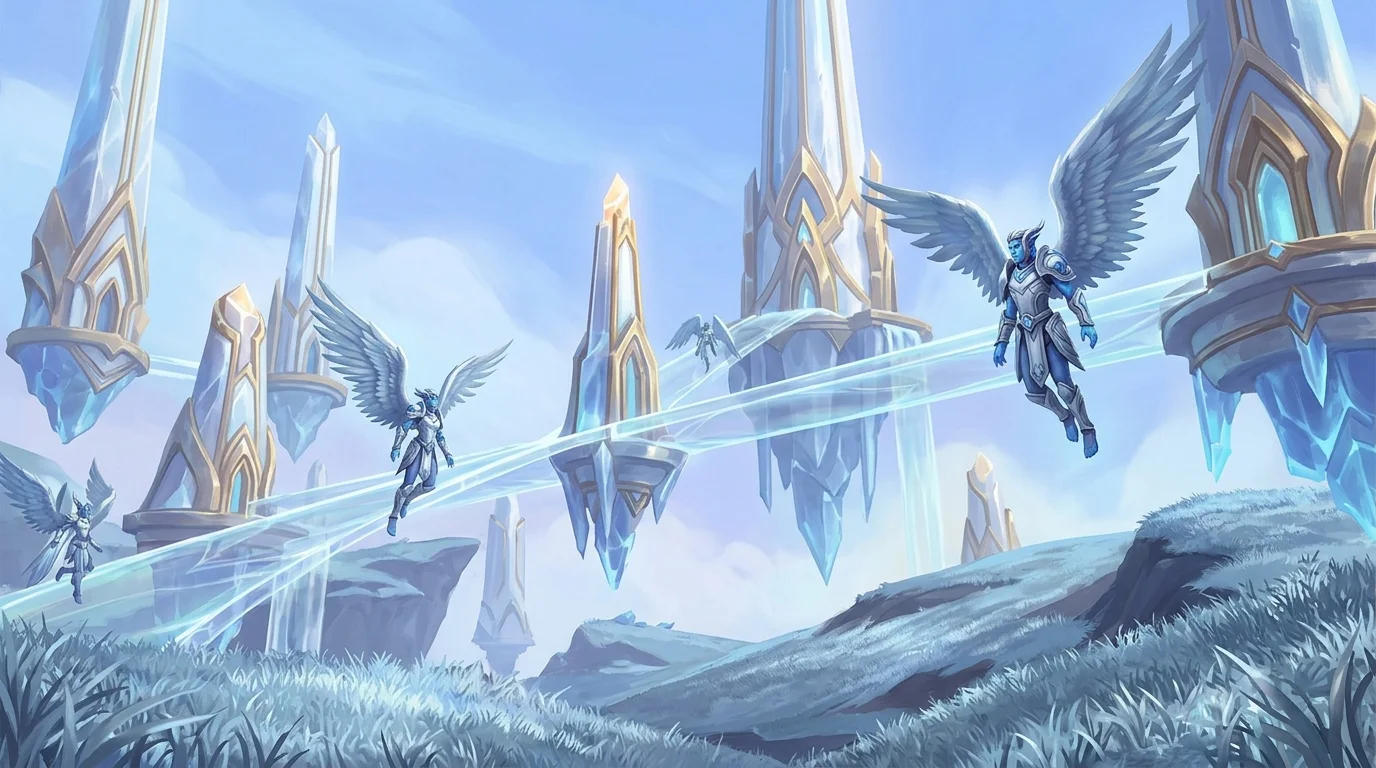
Bastion: Uther and the weight of trauma
The Bastion episode is probably the most devastating of the series.
What it shows
Uther arrives in the afterlife still marked by death at the hands of Arthas. In theory, Bastion exists to purify, order, and transform souls into servants of the cycle. In practice, the short film immediately shows a fissure: some pains do not enter any system cleanly.
Why does this episode weigh so much
Because it breaks Bastion's visual promise. Everything seems pure, luminous, elevated. But the short shows that behind this purity there is a real psychic cost. Uther does not enter Bastion as a resolved soul. He enters as someone too broken to fit in without violence.
Revendreth: Kael'thas and the possibility of redemption
If Bastion asks what happens to a wounded hero, Revendreth asks what happens to a proud and guilty soul.
Kael'thas' arc
Kael'thas is the perfect choice for this episode because he embodies excess, arrogance, and personal ruin. In Revendreth, it's never just about punishment. It is if there is still a way back.
The short makes this clear: redemption in Revendreth is not comfort. It is ritualized confrontation, humiliation and insistence.
Maldraxxus: Draka and the logic of survival
The Maldraxxus episode does an interesting job because it deviates from the simplistic idea that this kingdom is just “the place of dead warriors”.
What Draka reveals
Draka does not arrive as a ready-made legend. She arrives as someone who needs to prove usefulness in a brutal system. Maldraxxus presents itself, from the beginning, as a kingdom where strength is not just muscle. It is adaptation, reading power and institutional survival.
This goes a long way toward understanding why Maldraxxus seems so chaotic: order there has never been kindness. It was always military efficiency.
Ardenweald: Ysera and Legion continuity
The Ardenweald episode is perhaps the most beautiful in a contemplative sense, and that is no accident.
What does he do
Upon receiving Ysera, Ardenweald presents itself as a kingdom of care, sleep and rebirth. But the short avoids turning this into easy peace. The world is in an emotional crisis. Even here, where the cycle of nature should seem safe, there is a real threat of collapse.
Ysera works as the perfect emotional bridge because she directly carries Legion's grief into Shadowlands.
What Afterlives gets right better than the expansion itself in some moments
The series has a rare advantage: brevity. Each episode chooses a character, a conflict and a kingdom. This requires clarity.
The result
Afterlives manages to sell the fantasy of each zone with more focus than many hours of the main campaign:
- Bastion as purity that charges too much;
- Revendreth as redemption under ritual violence;
- Maldraxxus as a military machine from beyond;
- Ardenweald as a threatened natural cycle.
In just a few minutes, the series fixes the DNA of each kingdom.
Why Afterlives was the best gateway to Shadowlands
Shadowlands was risky because it changed the scale of the universe so much. After so many expansions centered on Azeroth, taking the player to the afterlife required narrative confidence.
Afterlives delivered that confidence. Not because it explained everything, but because it showed that the afterlife in Warcraft would still be about characters, choices, pain, and destiny — not just beautiful architecture and new systems.
What does each short leave as a question
This is another merit of the series: it doesn't close too much.
- Bastion leaves the ethical question of erasure.
- Revendreth leaves the question of who deserves redemption.
- Maldraxxus leaves the question of what unbridled power produces.
- Ardenweald leaves the question of what happens when even the natural cycle fails.
These questions are better than quick answers. They carry the entire expansion.
Minimum recommendation
If you want to understand why Afterlives was one of Blizzard's best promotional materials, look at the series as a dramatic prologue, not as marketing. The shorts work because they present cosmology through characters who suffer. And when the afterlife manages to hurt, it finally seems real.
Posts Recomendados
Revendreth as a Redemption Study: What the Venthyr Really Do to Souls
Revendreth is the realm of proud and guilty souls, run by the Venthyr. His promise is redemption; its danger is to transform atonement into a system of power.
Bastion and the Price of Duty: What the Kyrian Give Up to Serve
Bastion promises purity, service and ascension, but to become Kyrian the soul must give up deep memories and pain. Is duty still virtuous at such a cost?
Magtheridon: the pit lord of Hellfire Citadel
Who is Magtheridon: the pit lord who ruled Outland, lost the Black Temple to Illidan and became the blood source for fel orcs in Hellfire Citadel.
Saurfang and Dranosh: father and son of the Horde
Varok and Dranosh Saurfang: the son hidden in Nagrand, his death at the Wrathgate, the Deathbringer in ICC and the father who takes him home. Full arc.