
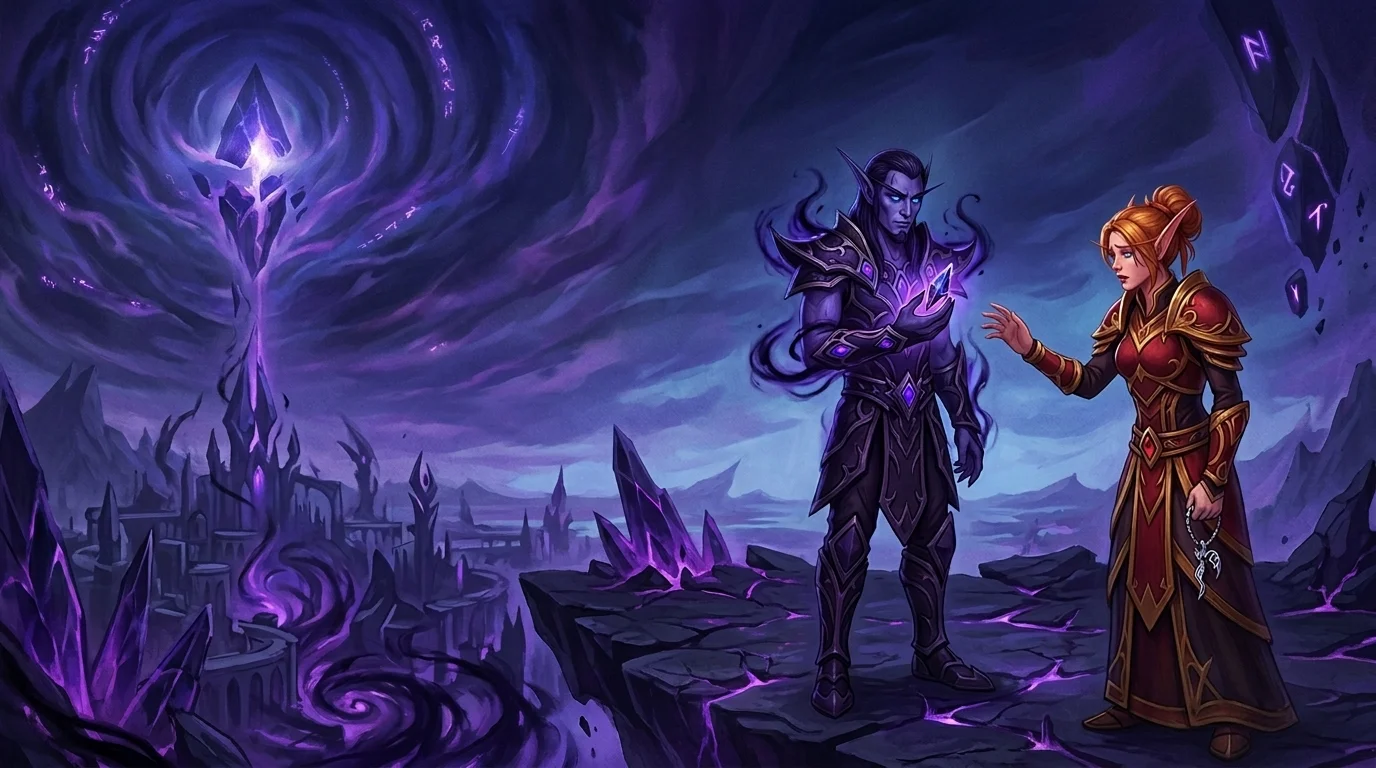
The Quiet at the End of Us: analysis of the tale of friendship and loss in Midnight
Not every great Warcraft tale needs a war
Warcraft is often remembered for armies, betrayals, ancient gods, and apocalyptic battles. That's why The Quiet at the End of Us draws so much attention. The tale chooses a much smaller scale. Instead of presenting a grand military plan or a central villain, it puts intimacy at the center of the experience.
It's a strong decision. Because when an expansion like Midnight promises Light, Emptiness, and the fate of entire peoples, a tale about friendship and loss does the work that epic material alone can't do: it remembers that every cosmic collapse always ends up being felt by concrete people.
What happens in The Quiet at the End of Us
The short story follows the connection between Orweyna and Amarakk. The bond between the two drives the entire story. There is no feeling that characters are there to “explain lore”; they are there to live a relationship, cross time and feel the weight of what changes.
What unites them
What sustains the tale is precisely what it does not try to exaggerate. Friendship is treated without grandiloquence. Not as an abstract symbol, but as coexistence, presence and care. This makes the narrative more fragile in the best sense of the word: more human, more delicate, more difficult to forget.
What does this story do differently in relation to other Midnight media
Midnight is already surrounded by materials that talk about threat, military march, cosmic crisis and geopolitical reorganization. The Quiet at the End of Us provides the counterpoint.
Personal scale, not epic
Here, Blizzard isn't trying to enlarge the map. It's trying to deepen the heart. The text asks less “what will happen to Azeroth?” and more “what happens to someone when the world around them changes too quickly?”.
This shift is important because it prevents Midnight from becoming an expansion made only of giant slogans. The tale injects vulnerability into the setting.
Friendship as a central theme
Choosing friendship as an axis is not a detail. It's an editorial decision.
Why this matters
Warcraft has always known how to work well with rivalry, honor, duty, revenge and sacrifice. But deep friendship, without relying on romance or immediate war, appears less often than it might. When it appears well, it tends to greatly expand the universe.
The Quiet at the End of Us understands this. He doesn't use friendship as emotional decoration. Use it as a narrative structure. Everything passes through it: memory, identity, fear of the end, a sense of continuity and the pain of realizing that not every connection survives time intact.
Loss as the main arc
The title already sets the stage. This is a tale of stillness, of endings, and of what remains when something important ceases to exist the way it once did.
What is lost here
The tale does not rely on spectacular death or colossal destruction to produce pain. The loss appears in a more subtle way:
- loss of a previous state of affairs;
- loss of innocence;
- loss of permanence;
- loss of the illusion that certain bonds are frozen in time.
This is what makes the text so strong. He understands that grief is not always explosive. Sometimes it's silent. Sometimes this is precisely what makes it worse.
How this story talks to Midnight
Midnight is an expansion that deals with identity, faith, heritage, trauma, and invasion of the Void. In the midst of all this, The Quiet at the End of Us helps to establish a simple idea: great threats don't just destroy cities and front lines. They change relationships.
The echo in the main campaign
Even when the tale doesn't directly explain a major campaign event, it emotionally prepares the player for the kind of loss that Midnight wants to explore. And that's valuable because it makes the world feel more cohesive. The campaign shows the broad conflict; the tale shows the intimate cost.
Why this is a great example of lore expansion
Much supplementary media fails because it tries to function as an explanatory appendix. You read it and feel like you only received technical context. Not here.
The merit of the story
The Quiet at the End of Us expands the universe without relying on:
- new boss;
- cosmic revelation;
- decisive battle;
- power turnaround.
It expands the lore by showing emotional texture. This is much more difficult than it seems. And when it works, it changes the way the player sees the main world.
What Blizzard gets right in this type of material
This tale proves that Blizzard understands something essential about modern Warcraft: the universe only remains relevant if it also knows how to slow down. It’s not enough to shout that “the fate of the world is at stake” all the time. We need to remember who lives in this world.
The Quiet at the End of Us does just that. It doesn't try to compete with the main campaign. He humanizes her.
Minimum recommendation
Read The Quiet at the End of Us without looking for “big plot twist”. The value of the tale lies elsewhere. It serves to show how friendship and loss can carry as much narrative weight as war and prophecy. To understand Midnight more completely, this is the type of text that is valuable precisely because it chooses to be small.
Posts Recomendados
Faith & Flame: analysis of the tale of Faerin Lothar and the weight of faith in Midnight
Faith & Flame shows Faerin Lothar before she became a symbol, with faith as a tested calling. See the bridge between Hallowfall and Midnight's Light.
Heartlands: analysis of the official tale that prepared the political reorganization of The War Within
Heartlands isn't just a transition tale: Blizzard reorganizes Azeroth's political voices after Dalaran's fall. See who still speaks for real cooperation.
Magtheridon: the pit lord of Hellfire Citadel
Who is Magtheridon: the pit lord who ruled Outland, lost the Black Temple to Illidan and became the blood source for fel orcs in Hellfire Citadel.
Saurfang and Dranosh: father and son of the Horde
Varok and Dranosh Saurfang: the son hidden in Nagrand, his death at the Wrathgate, the Deathbringer in ICC and the father who takes him home. Full arc.