
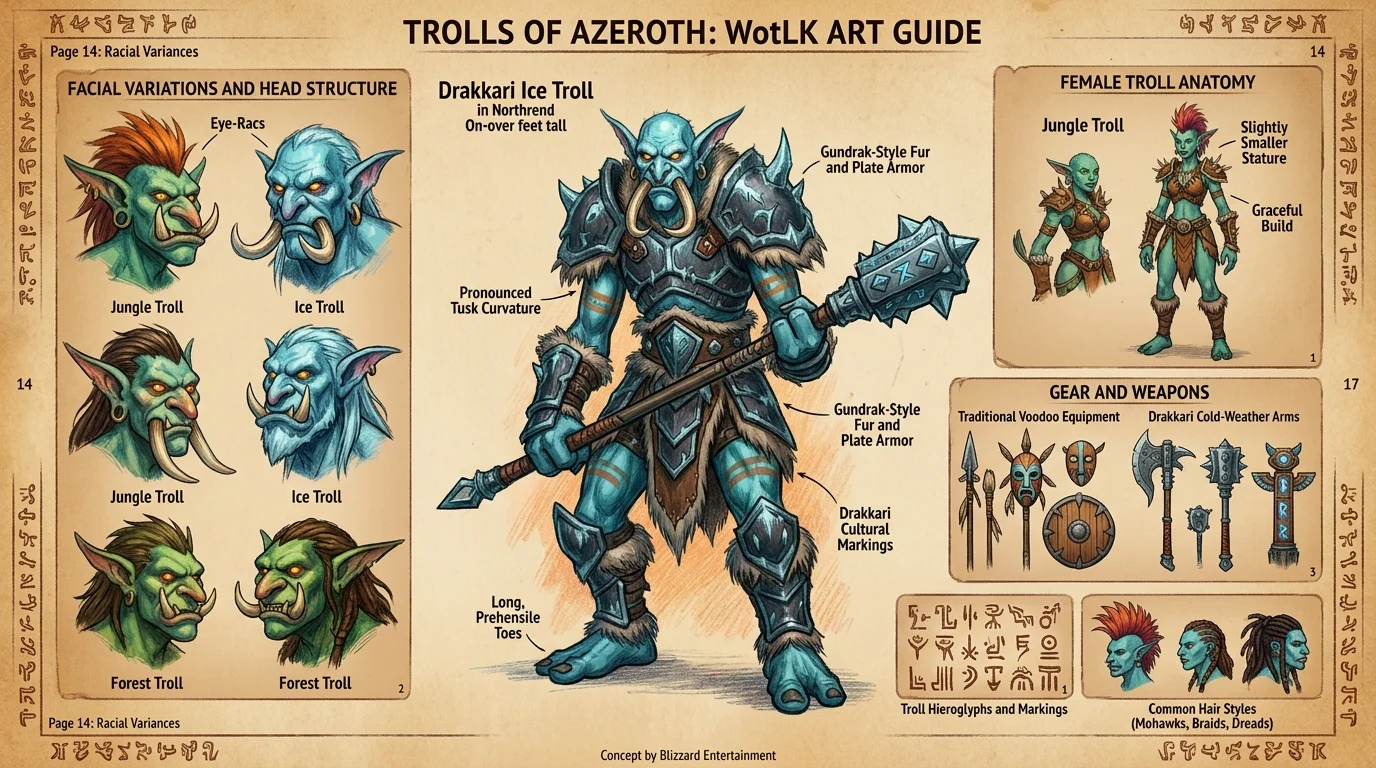
Trolls existed long before many of WoW’s “main races”
Trolls are sometimes treated by players as a sum of exotic tribes, strong accents and dungeons spread across the map. This does injustice to the size of their historical role. They are among the oldest people on Azeroth and have built huge empires when most of the best-known civilizations did not yet exist.
To understand trolls in Warcraft is to understand empire, living religion, historical fragmentation and radical adaptation to the fall.
The great troll empires
Amani
Mainly linked to northern Lordaeron and the forests of Quel'Thalas. Their story is inseparable from their hatred of elves, because the Amani see Quel'Thalas as a land built on troll loss.
Gurubashi
Southern empire, associated with Stranglethorn and a long history of glory, internal division and decay.
Zandalari
The Zandalari function as origin, memory and prestige. They are seen as a learned, priestly people and historically central to the broader troll identity.
Drakkari
In Northrend, the ice trolls show the harshest adaptation to the extreme environment and collapse brought by the Scourge.
What's left of each empire
The troll story in WoW isn't just about ascension. It's about survival after fragmentation.
| Empire / people | What did it represent | What's left | |----------------|--------------------|--------------| | Amani | territorial pride and war against elves | memory of revenge and resistance | | Gurubashi | great southern power | ruins, cults and restoration attempts | | Zandalari | spiritual and historical center | political reinvention in Zandalar | | Drakkari | glacial adaptation and bastion in Northrend | religious tragedy in Zul'Drak |
Loa: the troll gods
One of the richest parts of troll culture is that their religion doesn't seem distant or abstract. The loa are real, close forces, often personified and with their own agendas.
They can be:
- protectors
- collectors
- partners
- manipulators
- symbols of local identity
This gives troll lore a rare density. Their religion is not background; it is politics, war, legitimacy and survival.
Vol’jin and the modern Horde
Vol'jin matters because he brings the troll heritage to the heart of the Horde without completely diluting it. He is not “troll turned honorary orc”. He is a leader who carries the memory of his people into a larger coalition.
With him, modern Horde trolls gain:
- political dignity
- moral protagonism
- real tension with the Zandalari's imperial projects
- strong link between tradition and present
Troll presence in WotLK
Wrath of the Lich King reinforces very well that Northrend is also a troll continent.
Zul’Drak
It is perhaps the strongest example of a troll civilization in spiritual collapse. The Drakkari sacrificing their own loa is one of the expansion's heaviest stories.
Drak'Tharon
Reinforces the territorial and historical weight of ice trolls within the continent.
The feeling of living ruin
WotLK doesn't just show trolls as mobs. It shows a people trying to survive the combination of ice, war and necromancy.
What do trolls represent in WoW
Trolls are important because they carry something that Warcraft does very well: ancient people who haven't completely disappeared. They lost empires, territory and unity, but they did not lose memory.
This memory appears as:
- religion
- language
- resentment
- regionalism
- recurring desire for reconstruction
Minimum recommendation
To understand trolls in Azeroth more fully:
- treat Amani, Gurubashi, Zandalari and Drakkari as different traditions
- see the loa as a real cultural axis, not just flavor
- use Vol’jin as a bridge between ancient empire and modern Horde
- reread Zul’Drak as a troll tragedy, not just a quest zone
- remember that troll history is that of broken empires that never forgot what they were
Posts Recomendados
Legacy of the Amani: the trolls of Quel'Thalas and the hatred accumulated over centuries
Legacy of the Amani doesn't treat the Amani and Quel'Thalas as a generic backdrop: the tale turns centuries of war into personal, political memory.
Zandalar in Depth: The Cradle of Troll Civilization and the Legacy of Rastakhan
Zandalar is more than a BfA setting: it is the historic heart of troll civilization, an empire shaken by betrayal and redefined by Talanji's rise.
Magtheridon: the pit lord of Hellfire Citadel
Who is Magtheridon: the pit lord who ruled Outland, lost the Black Temple to Illidan and became the blood source for fel orcs in Hellfire Citadel.
Saurfang and Dranosh: father and son of the Horde
Varok and Dranosh Saurfang: the son hidden in Nagrand, his death at the Wrathgate, the Deathbringer in ICC and the father who takes him home. Full arc.