
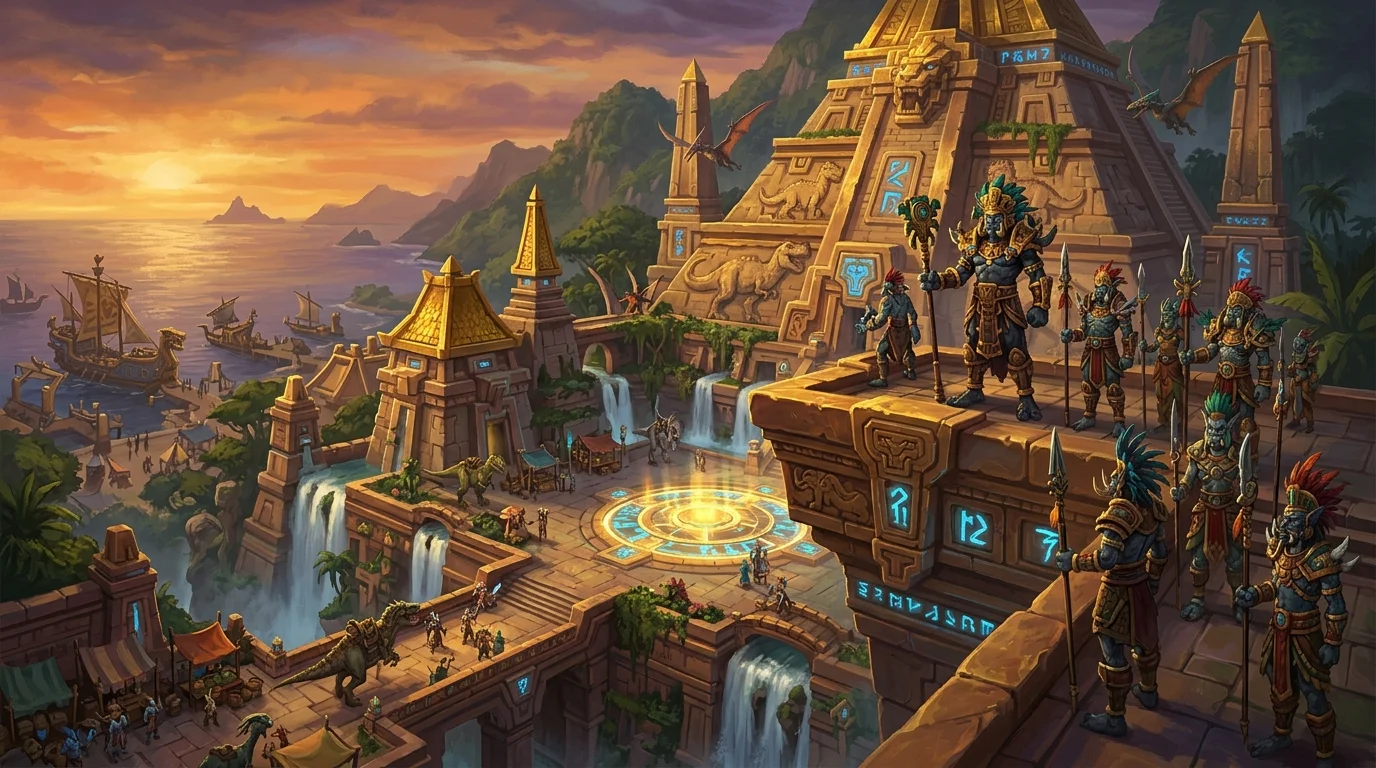
Zandalar in Depth: The Cradle of Troll Civilization and the Legacy of Rastakhan
Zandalar isn't just another troll kingdom — it's the original reference
Much of Zandalar's strength in Battle for Azeroth comes from a simple idea: it is not a fringe of the troll world. It is the historical, spiritual and symbolic heart of the troll civilization.
This changes everything. When Zandalar goes into crisis, we're not just seeing a weakened kingdom. We are seeing an ancient civilization trying to survive the weight of its own greatness.
The spiritual center of trolls
The sacred mountain and Atal'Dazar
Zandalar bears the weight of the ancient troll empire and its religious continuity. The sacred space is not just ornamental: it organizes legitimacy, tradition and relationship with the loa.
Living history, not museum
The most interesting thing is that Zandalar does not appear as a dead past. It is an empire still alive, still ritualized, still convinced of its historical centrality.
The political structure of Rastakhan
An almost sacred king
Rastakhan is not just an administrative ruler. Its power is monarchical, symbolic and religious. His figure condenses dynastic authority and spiritual legitimacy.
The role of the Zanchuli
The Zanchuli function as a layer of advice, intrigue and administration close to the throne. This makes Zandalar feel like a real imperial court, not just a quest setting.
Loa, power and identity
Gonk, Bwonsamdi and Pa'ku
These lwa help to show that the Zandalari religion is not monolithic. Each figure expresses an aspect of the troll world: adaptation, death, flight, cunning, continuity and balance.
A kingdom also governed by pacts
Power in Zandalar is never entirely secular. Politics always meets with devotion, spiritual bargaining and ritual legitimacy.
Zul's betrayal and internal collapse
The empire was already under pressure
Zul doesn't create the problem out of nowhere. It channels existing weaknesses: insecurity, prophecy, erosion of central power and internal fractures.
When the center falters
The crisis caused by Zul shows something essential about Zandalar: ancient empires don't collapse just because of external enemies. They collapse when they stop believing in their own order.
Talanji and what she inherits
The weight of post-Rastakhan
Rastakhan's death does not end the story. She transfers the most difficult task to Talanji: governing without the same type of sacred aura, but still under the shadow of an empire that expects continuity.
Change with root
Talanji does not represent abandonment of Zandalar. It represents the attempt to update the kingdom without breaking what made it last so long.
What Zandalar represents in WoW
| Element | What it reveals | |----------|--------------| | Atal'Dazar | sacred antiquity and legitimacy | | Rastakhan | ritual monarchy and dynastic weight | | Zanchuli | court, advice and intrigue | | Loa | religion as a political structure | | Talanji | continuity with transformation |
Minimum recommendation
Zandalar works best when you read the kingdom as an empire in dispute with its own past.
It’s not just “the expansion of trolls”.
This is the moment when the cradle of troll civilization needs to decide how it continues to exist without pretending that nothing has changed.
Posts Recomendados
Isle of Thunder: Throne of Thunder, the return of Lei Shen and the mogu secrets
The Isle of Thunder isn't just Lei Shen's zone: it's where Mists of Pandaria digs up the mogu past, revisits the Zandalari and shows a resurrected tyrant.
Kul Tiras in depth: the three houses, naval tradition and independence as an identity
Kul Tiras isn't just a fleet. It's regional pride, rival houses, maritime tradition, political memory and a complicated bond with the Alliance and Jaina.
Magtheridon: the pit lord of Hellfire Citadel
Who is Magtheridon: the pit lord who ruled Outland, lost the Black Temple to Illidan and became the blood source for fel orcs in Hellfire Citadel.
Saurfang and Dranosh: father and son of the Horde
Varok and Dranosh Saurfang: the son hidden in Nagrand, his death at the Wrathgate, the Deathbringer in ICC and the father who takes him home. Full arc.