
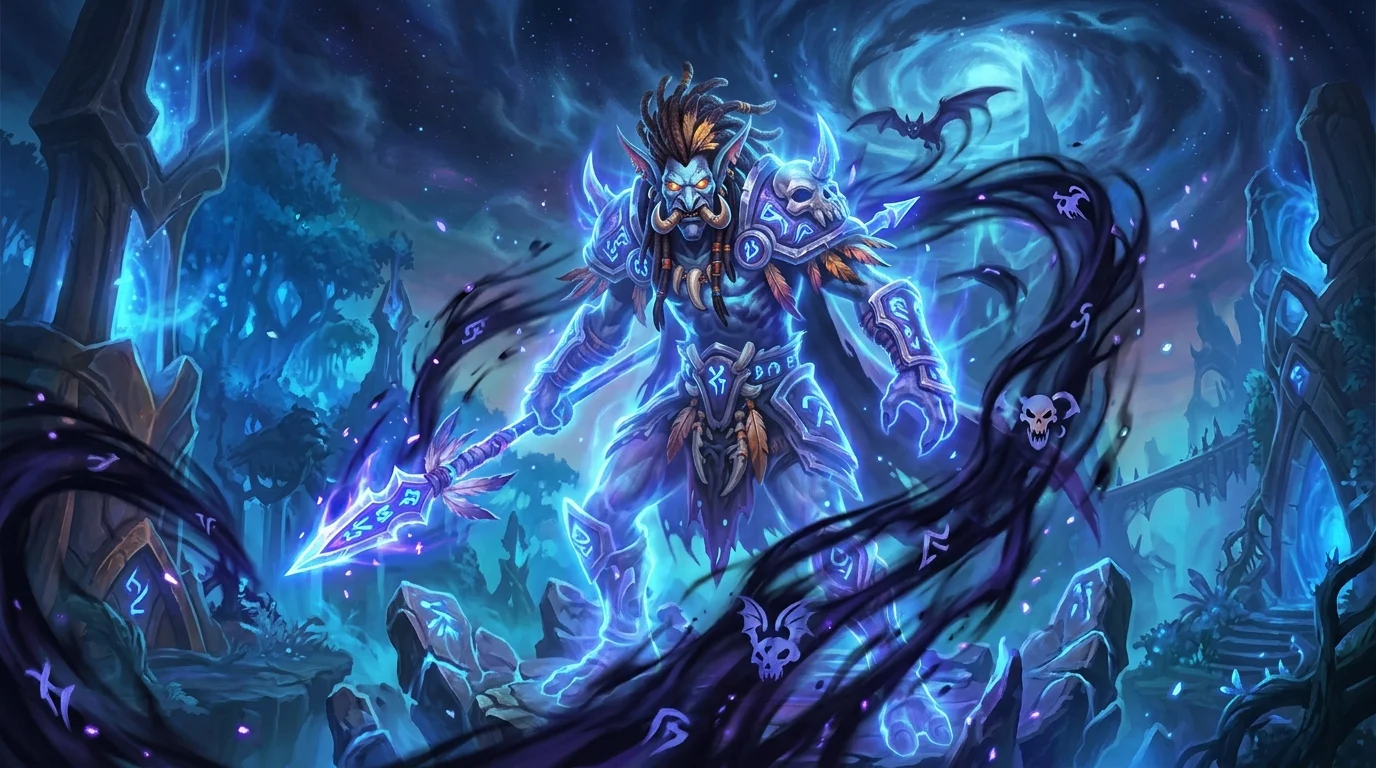
Vol'jin: From Reluctant Warchief to Spirit Guide Returned from the Afterlife
Vol'jin was never the biggest name in the Horde — and that's the key
Vol'jin did not command the largest army, did not come from the most powerful race, and never cultivated the aura of conqueror that so many Horde leaders tried to embody. Still, few characters carry so much moral authority. He is important because he represents a form of leadership that the Horde often threatens to forget: strength with memory, loyalty with limits, and honor without blind submission.
This is why Vol'jin works so well. He doesn't want the top. He rises because he sees the top being occupied by the wrong men.
Son of Sen'jin: born small in a world of empires
What this means
Vol'jin is born as heir to a people who never had the political size of the orcs, the ancient greatness of the elves or the ritual weight of the tauren. The Darkspear are a tribe, not an empire. And that's precisely why his worldview is different from the beginning.
He learns early that survival requires cunning, spirituality and a sharp reading of risk. You can't live on the fantasy of permanent greatness when your people are always at risk of being crushed by greater forces.
Father's legacy
Sen'jin leaves Vol'jin an inheritance that goes far beyond the position of chief:
- the obligation to protect the Darkspear before protecting personal pride
- the connection with the loa and troll spirituality
- healthy distrust in the face of alliances that are too powerful
- the notion that size does not define dignity
This basis explains why Vol'jin is never dazzled by the spectacle of power.
Resistance to Garrosh wasn’t an impulse — it was a moral reading
What happened
When Garrosh takes over as Warchief of the Horde and begins pushing it toward authoritarianism, orcish supremacy, and increasingly less justifiable brutality, Vol'jin is one of the first to realize that this isn't just "a harsh style of leadership." It was a deformation of the very idea of the Horde.
He is on a collision course early because he understands what many took time to accept: a corrupt leader doesn't just destroy campaigns. He destroys the entire coalition's sense of belonging.
Why this defines the character
Vol'jin does not break away out of wounded vanity. He breaks away because he sees limits.
He says "no" when saying "yes" would be safer. He accepts exile and persecution before becoming an accomplice. He would rather risk his own life than normalize a Horde built on humiliation and fear.
This profoundly sets him apart from many other leaders in the game.
Warchief for acclaim, not ambition
What happened
After Garrosh's fall, Vol'jin is elevated to Warchief not because he campaigned for it, but because he seemed the most worthy name at the time. This detail matters a lot. His legitimacy arises from accumulated trust, not from hunger for power.
What makes this ascension different
Vol'jin is the Warchief who most clearly enters the role without the desire to turn it into a personal project.
This changes everything.
- he doesn't need to prove that he is the strongest in the room
- he does not govern to display authority
- he does not try to refound the Horde in the image of his own ego
His rule is short, but symbolically enormous because it shows that the Horde could still recognize ethical leadership when it wanted to.
The Broken Shore and the question of the poisoned spear
What happened on the battlefield
On the Broken Shore, Vol'jin is wounded by a spear from a Legion warrior. The wound is real, physical and immediate. He is evacuated but does not recover. On the most direct plane, it was that blow that killed his body.
Where the mystery comes in
Vol'jin's death was never just a medical issue. The real enigma was another: why, in that terminal state, did he listen to the guidance to name Sylvanas as successor?
Years later, Shadowlands repositions this doubt. The revelation linked to Mueh'zala shows that spiritual manipulation on the deathbed was decisive. In other words: the weapon physically killed Vol'jin, but the distortion of the final moment came from a greater, more insidious influence.
What this changes in the reading of the character
Does this absolve Vol'jin? Not exactly in the sense of erasing consequences. But it changes the judgment. He didn't choose Sylvanas as a calculating politician. He was a dying, vulnerable man, struck precisely at the moment when his greatest virtue was to trust in something above himself.
His tragedy is there.
Shadowlands: the return as a spirit that still seeks an answer
What happens
Shadowlands does not treat Vol'jin as a closed case. On the contrary. The expansion assumes that his story is incomplete and uses this as a narrative engine. His spirit returns not to confirm an ancient glory, but to investigate his own end.
That's a really good choice of lore. Instead of transforming Vol'jin into a static myth, the game keeps his main hallmark alive: the need to understand before accepting.
His spiritual role
In the afterlife, Vol'jin does not return as a war general. He returns as a presence of passage, wisdom, search and transition. This totally suits the character.
He was important in life for seeing the moral limits of the Horde. And he remains important in death for refusing easy answers about his own destiny.
The bond with the loa is a central part of the character
What this means
Vol'jin was never just a tribal chief or a political commander. He has always been tied to the spiritual world of trolls. This distinguishes him from many Horde leaders, because he sees power and destiny as inseparable from memory, ancestry, and pact.
Why this matters at the end of life
It is precisely this openness to the spiritual that makes the final tragedy so bitter. The character who best knew how to listen to the invisible ends up being deceived at his most vulnerable moment.
This is not a cruel detail by chance. It is a closure consistent with his nature.
What differentiates Vol'jin from other Warchiefs
Vol'jin occupies a unique place because his authority never came from territorial conquest, cult of personality, or brute force.
He led by:
- coherence
- memory
- courage to go against his own faction
- commitment to a less imperial and more plural Horde ideal
This puts him in stark contrast to Garrosh as well as Sylvanas. While others treat the Horde as an instrument, Vol'jin treats it as a responsibility.
What he represents for the Horde
Ultimately, Vol'jin represents the question the Horde always needs to ask itself and almost never likes to hear:
up to what point is it still the Horde, and from what point did it become just a power machine?
That's why he remains so beloved. Not because he won more battles, but because he knew how to identify when the faction was losing its soul.
Minimum recommendation
If you want to truly understand Vol'jin, follow this order:
- formation as son of Sen'jin and leader of the Darkspear
- open resistance to Garrosh and the political price of this
- the acclaim as Warchief without a personal project of power
- Broken Shore as physical death and beginning of spiritual mystery
- Shadowlands as a continuation of the search for truth
Vol'jin is one of the strongest characters in WoW precisely because he never needed to appear bigger than he was. He knew who he was, he knew what his people needed, and he knew when duty required facing his own side.
Posts Recomendados
Baine Bloodhoof: the tauren leader between honor, diplomacy and his father's heritage
Baine Bloodhoof, son of Cairne, inherited a grieving people and an unstable Horde. His strength was the courage to say no when honor was put up for sale.
Gallywix: Trade Prince, opportunist and the goblin who shaped the Bilgewater Cartel
Gallywix is the purest goblin power in WoW: limitless profit, unbridled ego and an intelligence sharp enough to survive almost any disaster he faces.
Saurfang and Dranosh: father and son of the Horde
Varok and Dranosh Saurfang: the son hidden in Nagrand, his death at the Wrathgate, the Deathbringer in ICC and the father who takes him home. Full arc.
Dalaran in Northrend: why the city flew
Dalaran in Northrend: why the Kirin Tor took the city into the sky over Crystalsong, who rules it and what the Violet Hold keeps locked. See the summary.