
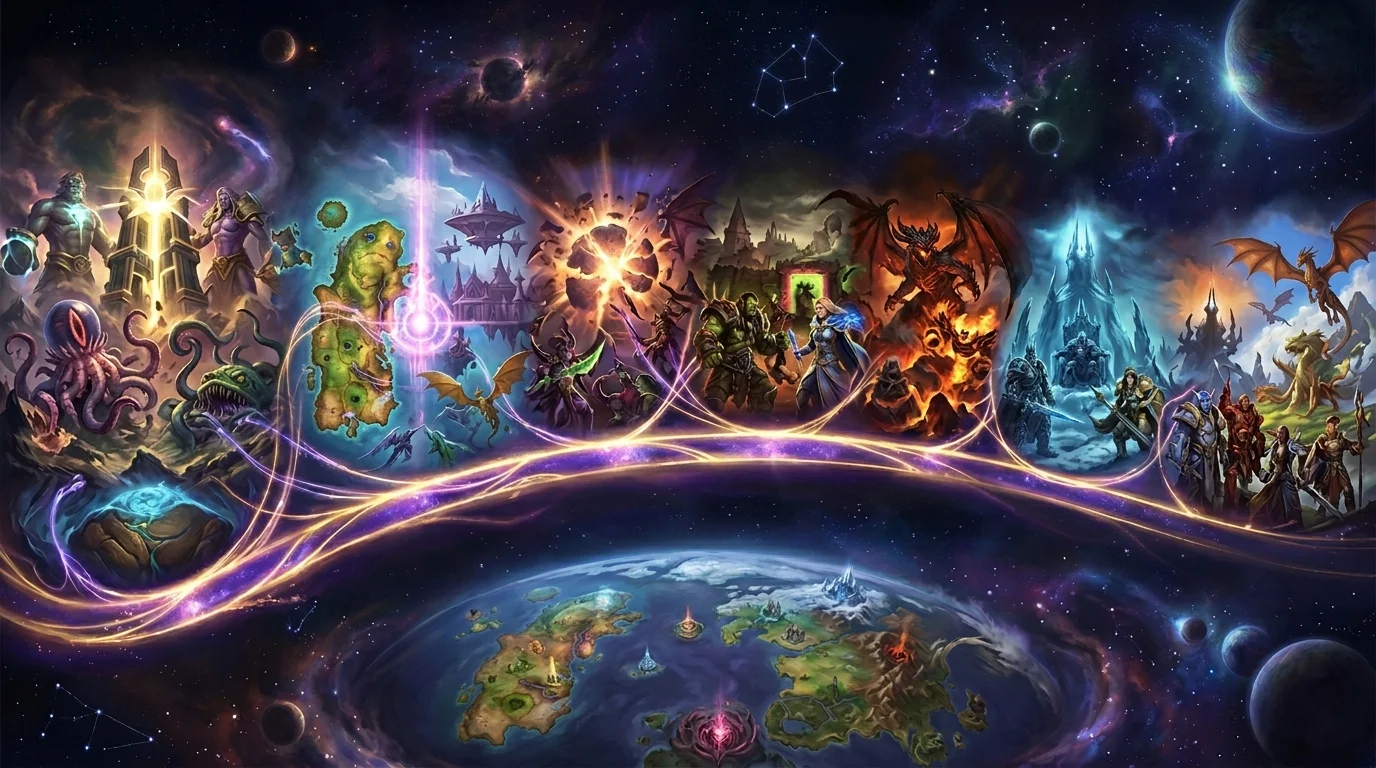
The full story of Azeroth: from beginning to end — chronology of the entire WoW lore
This post is a map, not the entire encyclopedia
If you try to tell the entire Warcraft story in a single text, the result almost always turns into a hurried list of names, wars, and fallen kingdoms. WoW lore is too big to work well like this.
So the proposal here is another: this post works as a navigable chronological index. Instead of smashing twenty years of history into a running summary, it organizes Azeroth by eras and shows where each phase begins, what it changes, and which post you should go to next to dig deeper.
The goal is simple: to give a clear view of the entire timeline, from the cosmic beginning to Midnight, without losing sight of the great threads that run through it all — Old Gods, Burning Legion, Void, the titanic cycle and the Worldsoul of Azeroth.
How to use this index
Reading caption:
- ✅ published — blog post already exists
- 📝 internal idea — agenda already mapped but not yet published
The order below follows a chronological logic. At some points, the same theme comes back later with another weight. That's no mistake: that's just how Warcraft lore works. Azeroth lives on cycles, echoes, and threats that seem defeated until they reappear in another form.
Before Time
Before empires, mortal races, and factions, the history of Warcraft was already driven by cosmic forces. This is where the most abstract concepts come in — Light, Void, life, death, world-souls, and the architecture of the cosmos. It is not the most "down to earth" part of the lore, but today it is one of the most important to understand the direction of the Worldsoul Saga.
This block is the foundation of almost everything that comes after. If you want to understand why Azeroth is so hotly contested, why the Old Gods aren't “local villains,” and why The Last Titan matters so much, this is where you need to start.
Posts to dive into
- ✅Post 392 — What are Worldsouls
- ✅Post 393 — Void Lords: the ultimate threat
- ✅Post 394 — The Naaru
- ✅Post 395 — First Ones: who built the Shadowlands
Foundation of Azeroth and titanic cosmology
After the cosmic backdrop, the story gains ground: the Titans find Azeroth, detect a world-soul in it, and shape the planet with their forges, guardians, and prisons. It is also here that the oldest conflict in all the history of the world is born: the war between the titanic order and the Old Gods.
This period explains why Azeroth was already born as a field of dispute. From early on, the planet was at the same time cradle, machine, prison and promise.
Posts to dive into
- ✅Post 324 — The Origin of Azeroth: Titans, Forge of the World, and the Imprisonment of the Old Gods
- ✅Post 360 — Titans vs. Old Gods: the war that shaped Azeroth
- ✅Post 361 — The nature of magic in Azeroth
Age of the Ancients and the fall of the first great elven world
Long before the Horde and Alliance, Azeroth had already seen a global catastrophe. The Well of Eternity, the arrogance of the kaldorei of the ancient empire, and the first major invasion of the Burning Legion led to the conflict that ended in the Sundering, tearing the world into continents and seas.
This is the first major trauma in Azeroth's planetary history. Almost everything that comes after — from Illidan to the Legion, from Azshara to the Naga, from the isolation of various civilizations to the fear of unbridled magic — is born here.
Posts to dive into
Warcraft I and II: Orcs, Draenor, the Blood Pact, and the birth of the Alliance
The “modern” story of Warcraft truly begins when Draenor goes on a collision course with Azeroth. Gul'dan's corruption of the orcs, the Blood Pact, the opening of the Dark Portal, and the first wars transform two worlds forever.
This is where the structural rivalry between Horde and Alliance is born, but this is also where something even greater is planted: the idea that mortal wars almost always serve much older and far more ambitious forces.
Posts to dive into
- ✅Post 326 — Draenor and the Blood Pact: Orcs, Draenei and Gul'dan
- ✅Post 327 — First and Second War: Dark Portal and the birth of the Alliance
- ✅Post 328 — Ner'zhul and the origin of the Scourge: the first Lich King
Warcraft III: the Third War and the Rise of the Lich King
If Warcraft I and II create geopolitical conflict, Warcraft III destroys any illusion of stability. Lordaeron falls, Arthas abandons the path of redemption, Quel'Thalas is devastated, and the Scourge shifts from a regional threat to a continental catastrophe.
This is the point at which Warcraft ceases to be just a war of kingdoms and also becomes a story of moral fall, necromancy, destiny and corruption on a full scale.
Posts to dive into
WoW Classic: Reconstruction, Factions in Friction, and Old Threats Reappearing
When WoW begins, Azeroth has already come out of several wars, but it is far from at peace. The factions try to reorganize, while buried or neglected threats return to the center: dragons, elementals, cults, and old world powers.
Classic is less about an “ultimate villain” and more about a planet still trying to understand the size of its own scars.
Posts to dive into
The Burning Crusade: Outland, Illidan and the Fate of the Blood Elves
TBC broadens the scale of the story. The threat is no longer just Azeroth but involves Outland, Illidan, Kael'thas, Lady Vashj and the very persistence of the Burning Legion. At the same time, blood elves live a decisive phase of identity, trauma and reconstruction.
This expansion acts as a bridge between the past opened by Warcraft III and the dark future that will end up in Northrend.
Posts to dive into
- ✅Post 331 — The Fate of Outland: Illidan, Kael'thas and what TBC left for WotLK
- ✅Post 284 — Quel'Thalas, the blood elves and the restoration of Sunwell
Wrath of the Lich King: Northrend, Titan Keepers, and the War Against Arthas
Wrath is where many players feel Warcraft reaches its most iconic point. But Northrend was never just Arthas. The continent carries vrykul, Nerubians, Ulduar, Yogg-Saron, Malygos, the Argent Crusade, and the Ebon Blade — all coexisting with the final campaign against the Lich King.
It is an expansion about war, yes, but also about legacy, buried civilizations and the moment when titanic cosmology begins to appear with more force for the average player.
Posts to dive into
- ✅Post 282 — Arthas before the fall
- ✅Post 283 — The fall of Lordaeron, Sylvanas and the birth of the Forsaken
- ✅Post 332 — Tirion Fordring, Ashbringer and the resistance against Scourge
- ✅Post 333 — The fall of the Vrykul and the birth of humanity
- ✅Post 285 — Ulduar, the Titan Keepers and Yogg-Saron
- ✅Post 286 — Malygos and the Nexus War
- ✅Post 287 — Vrykul, Nerubians and the roots of Northrend
- ✅Post 288 — Argent Crusade, Ebon Blade and the Fall of the Lich King
Cataclysm: Deathwing, Apocalyptic Cult, and the Broken World Again
Cataclysm changes Azeroth physically and symbolically. Deathwing returns, the world is remade in open wounds and the feeling becomes collapse on several fronts at the same time. It's not just an expansion about dragons: it's an expansion about disruption.
It is also here that the game emphasizes once and for all the link between planetary destruction, Old Gods and the fragility of the order maintained by the Titans and their agents.
Posts to dive into
- ✅Post 289 — The Cataclysm and the return of Deathwing
- ✅Post 290 — Twilight's Hammer, Elemental Lords and the Hour of Twilight
- ✅Post 291 — From Firelands to Dragon Soul: How Deathwing was defeated
Mists of Pandaria: Faction War, Sha, and the Moral Collapse of Garrosh
Pandaria seems, at first, a more contemplative pause. It's not. The expansion uses a hidden continent and a more serene aesthetic to talk about violent emotions, historical trauma, imperialism, and political radicalization.
The result is one of the most important turning points in the recent history of the game: Garrosh is no longer just an aggressive leader and becomes a central problem for the future of the Horde — and the world.
Posts to dive into
- ✅Post 292 — How Pandaria reappeared
- ✅Post 293 — The Sha, Shaohao and the weight of emotions
- ✅Post 294 — Lei Shen, the mogu and the Throne of Thunder
- ✅Post 295 — Corrupted Garrosh and the Siege of Orgrimmar
Warlords of Draenor: Alternate Timeline, Iron Horde, and the Return of Gul'dan
WoD looks like a detour, but it's not. Garrosh's escape and the creation of the alternative Draenor serve as a laboratory to retell the orc past in another light and, at the same time, reposition Gul'dan as the key to the Legion's return.
This expansion is less important for what it closes and more for what it prepares.
Posts to dive into
- ✅Post 296 — How Garrosh escaped and created the alternative Draenor
- ✅Post 297 — Iron Horde: warlords before corruption
- ✅Post 298 — Gul'dan, Hellfire Citadel and the bridge to Legion
Legion: the all-out war against Sargeras
Legion is the culmination of threads pulled since Warcraft III. The Burning Legion comes back at full force, Varian dies on the Broken Shore and Vol'jin leaves it mortally wounded, Illidan is recontextualized, Argus enters the scene, and Sargeras' own prison becomes part of the finale.
It's the expansion where WoW seems to solve one of its biggest arcs — but it does so by paving the way for even bigger questions about what comes after Legion.
Posts to dive into
- ✅Post 299 — Broken Shore and the return of the Burning Legion
- ✅Post 300 — Artifact Weapons and Class Halls
- ✅Post 301 — Suramar, the Nightborne and the War for the Nightwell
- ✅Post 302 — Illidan, Argus and the prison of Sargeras
Battle for Azeroth: Faction warfare returns, but that's not all
BfA sells the return of the war between Horde and Alliance, and in fact delivers it with enormous symbolic weight on Teldrassil and Lordaeron. But the expansion doesn't end there: Azshara, N'Zoth, and the Old Gods pull the focus back to the deeper conflict that has always been behind mortal crises.
It's a transitional expansion. It begins as political warfare and ends as the collapse of another layer of the world.
Posts to dive into
- ✅Post 303 — The Fourth War at a Glance
- ✅Post 303b — Teldrassil and Lordaeron
- ✅Post 304 — Kul Tiras and Jaina
- ✅Post 305 — Zandalar and Rastakhan
- ✅Post 306 — Azshara and N'Zoth
- ✅Post 307 — Visions of N'Zoth and the end of factional warfare
Shadowlands: the beyond as a system and breaking the cycle
Shadowlands takes Warcraft to its most metaphysical field. Sylvanas breaks the Helm of Domination, the sky is torn, and the game begins to explore realms of death that function as systems, institutions, and ideologies.
The expansion divides opinion, but it matters greatly for chronology because it redefines the place of death, soul, and destiny within the Warcraft universe.
Posts to dive into
- ✅Post 308 — Sylvanas breaks the Helm of Domination
- ✅Post 309 — Bastion, Maldraxxus, Ardenweald and Revendreth
- ✅Post 310 — The Jailer and Zereth Mortis
Dragonflight: Return to the Dragon Isles and Reconciliation with the Draconic Past
After Shadowlands, Dragonflight refocuses the story on Azeroth. The Aspects come back into focus, Neltharion is re-evaluated in a new light, the Primal Incarnates appear as opposition to the titanic order, and the game begins to align its pieces for the Worldsoul Saga.
Dragonflight seems more intimate than Legion or BfA, but its consequences are enormous. What it does best is reposition old questions for a bigger future.
Posts to dive into
- ✅Post 311 — The awakening of the Dragon Isles and the return of the Aspects
- ✅Post 312 — Raszageth and the Primal Incarnates
- ✅Post 313 — Neltharion, Aberrus and the secrets of black dragonflight
- ✅Post 314 — Fyrakk, Amirdrassil and the new beginning of night elves
- ✅Post 315 — Dark Heart: How Dragonflight Prepared The War Within
The War Within: The Underground of Azeroth and the Open Rise of Xal'atath
The War Within inaugurates the Worldsoul Saga in a concrete way: Khaz Algar, earthen, Nerubians, Azj-Kahet, K'aresh and Xal'atath make it clear that the struggle is no longer just for territories or crowns. Now the contest is for Azeroth's own soul.
This is the phase when the Void ceases to be a distant threat and starts to act frontally on the narrative heart of the game.
Posts to dive into
- ✅Post 316 — Khaz Algar, Earthen and Azeroth's new underground
- ✅Post 317 — Azj-Kahet, Ansurek and the rise of Xal'atath
- ✅Post 318 — Legacy of Arathor: Arathi and Rise of the Red Dawn
- ✅Post 319 — Ghosts of K'aresh and the Ethereals
- ✅Post 320 — The Warning: the prophecy of the fall of Quel'Thalas
Midnight: The Current Story
Midnight is the point where the threat of the Void finally hits Quel'Thalas head-on. The focus is no longer just preparation, but open invasion, conflict between Light and Void, the siege of the Sunwell, and Xal'atath's attempt to take Azeroth for a permanent night.
It is also the time when many ancient themes converge: blood elves, Sunwell, Alleria, Arator, Vereesa, the Amani, the legacy of the elven north, and the very question of to what extent the Light is truly synonymous with freedom.
Posts to dive into
- ✅Post 321 — Midnight: why Quel'Thalas became the center of the war
- ✅Post 322 — Alleria, Arator, Vereesa and the conflict between Light and Void
- ✅Post 323 — The Siege of Sunwell and the Early Chapters of Midnight
The Last Titan: What's Next
The Last Titan closes the Worldsoul Saga trilogy, but it still remains partially shrouded in mystery. What is already known points to the return to Northrend, Ulduar and a crisis involving the truth about the Titans and their role in Azeroth.
This closure promises less of a “simple final war” and more of a major adjustment of perspective: perhaps the decisive question is no longer who will win Azeroth, but what Azeroth really is — and who had the right to shape it from the start.
Posts to dive into
The threads that run through WoW's entire history
If you look at the entire chronology from above, some themes pop up repeatedly. They change shape, name and stage, but they keep going through everything.
1. Old Gods
The Old Gods are one of the most important constants in Azeroth's history. Even when they don't appear at the center of the expansion, their imprints keep popping up in cults, corruptions, buried empires, titanic prisons, and broken civilizations.
They function as the permanent reminder that Azeroth has always been a disputed world since before the mortal races.
2. Burning Legion
For a long time, the Burning Legion was the great axis of history. Almost the entire classic Warcraft arc revolves around it directly or indirectly: corrupted orcs, Illidan, Kael'thas, Arthas, Archimonde, Kil'jaeden, and Sargeras.
Even after the fall of Argus and the imprisonment of Sargeras, the Legion remains a central explanatory thread for understanding the past of many characters and peoples.
3. The Void
The Void spent years being treated as a lateral or indirect threat. Today that's over. Xal'atath, K'aresh, the Nerubians, the Sunwell, Alleria, and the Worldsoul Saga itself show that the Void has risen from the backdrop to the center of the narrative.
It is no longer a force that acts only in the shadows. It is a force vying for the future of the cosmos openly.
4. The titanic cycle and the Worldsoul of Azeroth
From the beginning, the Titans were presented as architects and guardians. But the further the story goes, the more the nagging question arises: order for whom? protection at what cost?
The Worldsoul of Azeroth seems to be the real heart of the whole modern saga. If The War Within and Midnight are about the contest for that soul, The Last Titan will likely be about the ultimate truth of that contest.
The current state of the story — and what's still open
Today, the arrival point of this chronology is Midnight. War is already in Quel'Thalas, Xal'atath operates openly, the Sunwell is once again the center of contention, and the line between protective Light and imposing Light is more fragile than ever.
But what remains open is precisely what makes this moment so good to follow Warcraft:
- what Xal'atath really wants from the soul of Azeroth
- what the Titans hid about the world they shaped
- what is the truth behind the “last” stage of the Worldsoul Saga
- and who or what is, after all, the Last Titan of the title
The best way to keep track of this is not to try to memorize the entire lore at once. It is to understand the order of the large blocks, to recognize the threads that connect each expansion and to deepen each phase calmly.
This post exists for that.
Minimum recommendation
If you want to understand WoW lore without getting lost:
- start with the cosmic origin and foundation of Azeroth
- then go through the three great wars and the fall of Arthas
- use Legion, Dragonflight, The War Within and Midnight as the axis of the modern phase
- treat Old Gods, Void, Titans, and Worldsoul as the backbone of the entire chronology
- use this index as a map — and move on to the in-depth posts for each era
Posts Recomendados
The origin of Azeroth: Titans, forging the world and birth of the Old Gods
Before any war, before any race, there were the Titans. They forged Azeroth — but the Old Gods were already there, corrupting the world before their arrival.
Dark Heart: How Dragonflight Paved the Way for The War Within
Dark Heart turns Dragonflight's ending from epilogue into prologue. Learn why patch 10.2.7 is the direct bridge to The War Within and the Worldsoul Saga.
Magtheridon: the pit lord of Hellfire Citadel
Who is Magtheridon: the pit lord who ruled Outland, lost the Black Temple to Illidan and became the blood source for fel orcs in Hellfire Citadel.
Saurfang and Dranosh: father and son of the Horde
Varok and Dranosh Saurfang: the son hidden in Nagrand, his death at the Wrathgate, the Deathbringer in ICC and the father who takes him home. Full arc.